
Positions Berlin
10.Sep - 13.Sep 2020
For its seventh edition, POSITIONS Berlin moves for the first time to Hangar 3 & 4 at Berlin-Tempelhof Airport and offers its visitors an attractive supporting program as official partner of the parallel Berlin Art Week.
This time together with the April postponed edition of paper positions berlin, photo basel and Fashion POSITIONS, parallel to the Berlin Gallery Weekend.
Artists: Gunda Förster, Constantin Schroeder, Leszek Skurski, Miriam Vlaming
Location: Tempelhof Airport - Hangar 3 & 4
Columbiadamm 10, 10965 Berlin


Gunda Förster
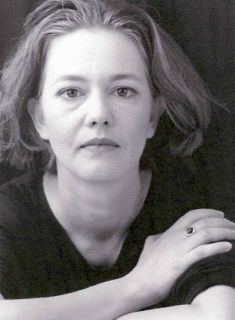
Based on an expanded concept of the image, the light-space-movement and time in the network of relationships between art and everyday life are the fundamental aspects of Gunda Förster's artistic work. Her space-related works can be understood as painting with contemporary methods or places of body and space perception that play with spatial reflection, but also social and perceptual-psychological conditions from the most diverse creative means. An important element of her work is defining and breaking boundaries - the architecture of space, of the image, the boundary between art and everyday life, between art, architecture, design and advertising, practical and theoretical debate, product and process, private and public, and reality and appearance. The formal reduction of her works determines their symbolic quality. The significance is only revealed by linking the most diverse aspects and their meanings. Essentially, Gunda Förster’s works focus on the correspondence between light, space, movement, and time as aspects that are constantly present in everyday life as well as in art.
To the artist page
Constantin Schroeder
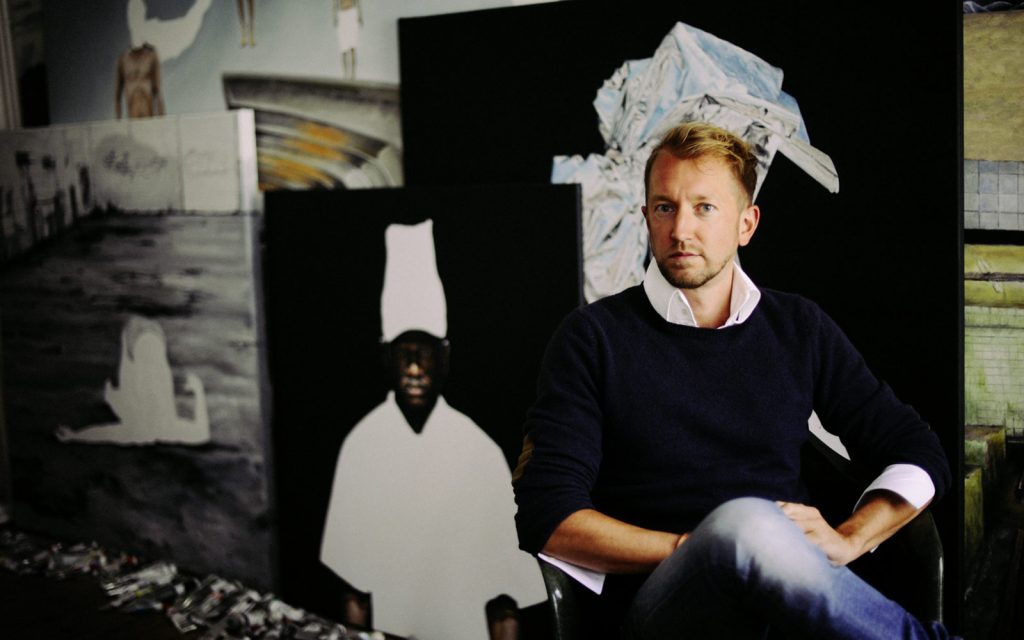
Constantin Schroeder's figurative paintings are impressive, moving images with a profound sense of depth. His pictorial protagonists are fascinating characters that never let us go. Internalizing the present with all its complexities, he uses a very reduced color palette. Mostly executed in large formats, the scenes captivate the viewer with their characteristic narratives. Schroeder reaches deep into the archive of the human psyche. His works reveal an enigmatic iconography, which includes young heroes posing interpersonal mysteries. The artist, who lives and works in Berlin and studied theology, philosophy, and art history, also illuminates the darker sides of life in an extraordinary, hyper-realistic style. These are powerful images that captivate us with their enigmatic pictorial content. Schroeder leaves some parts of the image white, which allows the viewer to develop his or her own interpretation and understanding of the image through open associations.
To the artist page
Leszek Skurski

"Condensation is the starting point of my painting."
- Leszek Skurski
This guiding principle forms the foundation upon which Leszek Skurski builds his visual worlds. His journey began at the Academy of Fine Arts in Gdańsk, where, at the age of just 22, he was honored with the Polish State Prize for Painting. Over the decades, he has perfected a signature style that moves between the fleeting and the enduring, and today is recognized as Neo-Impressionism. His works are the result of heightened attentiveness and a persistent commitment to decisions that, once placed on the canvas, must stand on their own.
In these compositions, white becomes the true protagonist. It is not an empty background, but a pulsating, expansive surface that lays bare every movement and mark without protection. What remains in this space has passed the test of reduction. Skurski’s figures, often caught in waiting or transition, do not embody mere actions but a quiet, existential presence. By letting the faces recede in favor of posture, the viewer’s gaze is freed to perceive a being that transcends the individual.
It is this deliberate omission of detail that conjures a calm in which time loses its usual pace. Fleeting moments of daily life, memories of what has been seen, and deep sensations merge here until they coalesce into a single, concentrated situation. A space emerges in which the everyday loses its casualness and acquires a timeless validity. What remains is the essential, a silent and powerful assertion of the moment that resonates far beyond the edges of the canvas.
To the artist page
Miriam Vlaming
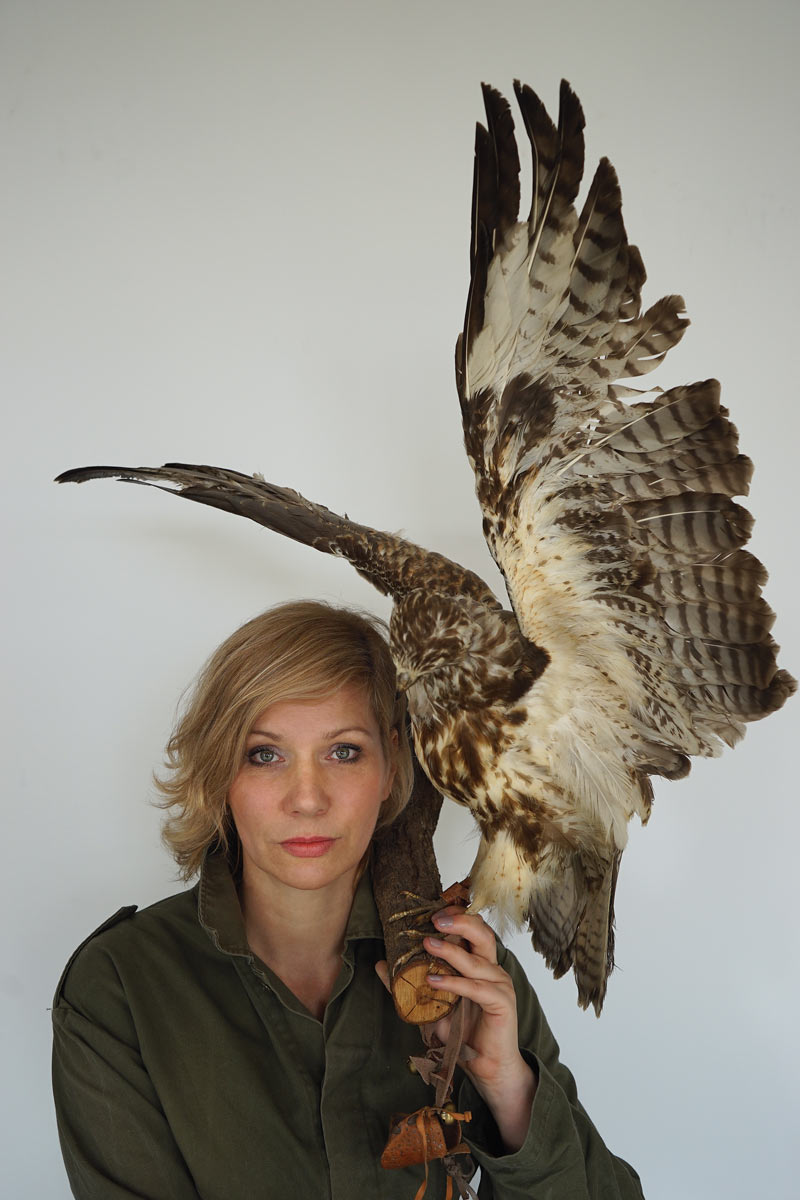
In Miriam Vlaming's large-scale paintings in egg tempera, the painter breaks down the boundaries between man and nature as well as past and reality. She creates a harmonious symbiosis between these supposed opposites through hazy layers created by the application and removal of paint. In doing so, she allows the depicted figures to emerge from a natural, dreamlike environment. Through this aesthetic, Vlaming opens the viewer's eyes to the multifaceted aspects and philosophical questions of being human, which she addresses in her paintings. Miriam Vlaming always has the overall picture in mind in her mysterious pictorial worlds. She plays with ambiguous metaphors. “Disruptions and contradictions interest me ... the moment after or before something has happened...not the history." Her egg tempera paintings satisfy a deep human need for knowledge. The important member of the New Leipzig School studied at times with Neo Rauch. She was a master’s student under the direction of Arno Rink and is represented in numerous public and private collections.
To the artist page