
Art Karlsruhe
05.Mar - 08.Mar 2015
We would like to invite you to our booth (M11) in hall 4. This year we present as a highlight for the first time three solo shows with fair-exclusive works by Michael Dohr, Alfred Haberpointner and Leszek Skurski. Also represented are the artist Gunda Förster and Josef Hirthammer.
Alfred Haberpointner
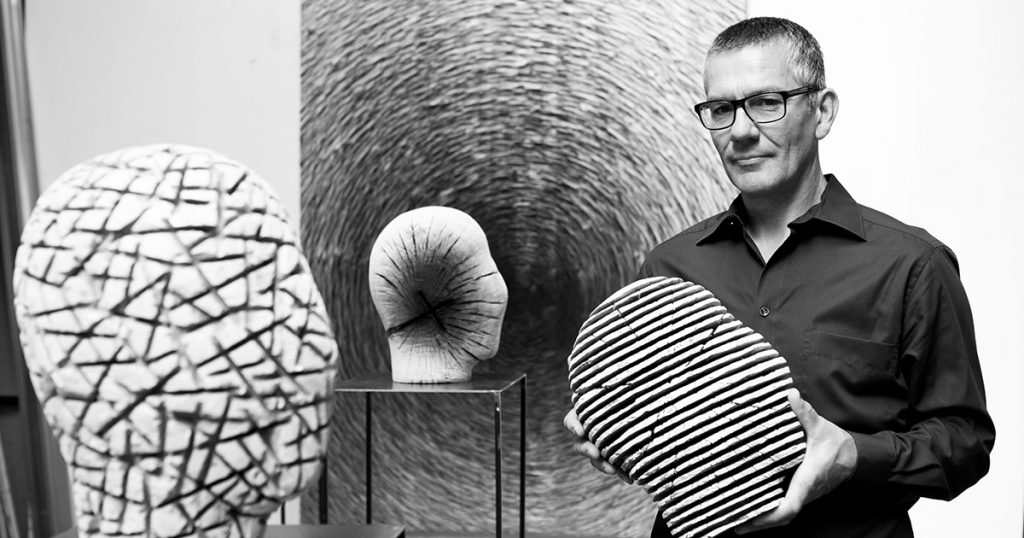
Salzburg-born sculptor Alfred Haberpointner creates wooden sculptures that oscillate between an abstract, geometric form and a figurative image. With his work series spanning over the last two decades, Haberpointner proves how he has innovatively dealt with wooden materials and freed himself from the roots of craft-based, naturalistic wooden sculpture. In his "chopped images," he gives the wooden material an intense presence through systematic, rhythmic sections, which emerge through close observation and exploration of the textured surfaces and result in a dance between light and shadow. He is concerned with form in his works, particularly in the treatment of wood in all possible nuances and shadings. In each of his artworks, one can see the traces of the work process: Haberpointner subjects his reliefs and sculptures to a powerful, mechanical work process that leaves traces on the works. Through beating, chopping, and burning, textures emerge that give the works a relief-like surface, which lacks any mathematical precision and exudes a special aura. Alfred Haberpointner is represented in major art collections, such as the Würth Collection.
To the artist page
Leszek Skurski

"Condensation is the starting point of my painting."
- Leszek Skurski
This guiding principle forms the foundation upon which Leszek Skurski builds his visual worlds. His journey began at the Academy of Fine Arts in Gdańsk, where, at the age of just 22, he was honored with the Polish State Prize for Painting. Over the decades, he has perfected a signature style that moves between the fleeting and the enduring, and today is recognized as Neo-Impressionism. His works are the result of heightened attentiveness and a persistent commitment to decisions that, once placed on the canvas, must stand on their own.
In these compositions, white becomes the true protagonist. It is not an empty background, but a pulsating, expansive surface that lays bare every movement and mark without protection. What remains in this space has passed the test of reduction. Skurski’s figures, often caught in waiting or transition, do not embody mere actions but a quiet, existential presence. By letting the faces recede in favor of posture, the viewer’s gaze is freed to perceive a being that transcends the individual.
It is this deliberate omission of detail that conjures a calm in which time loses its usual pace. Fleeting moments of daily life, memories of what has been seen, and deep sensations merge here until they coalesce into a single, concentrated situation. A space emerges in which the everyday loses its casualness and acquires a timeless validity. What remains is the essential, a silent and powerful assertion of the moment that resonates far beyond the edges of the canvas.
To the artist page