
POSITIONS Berlin
12.Sep - 15.Sep 2024


Laura Aberham
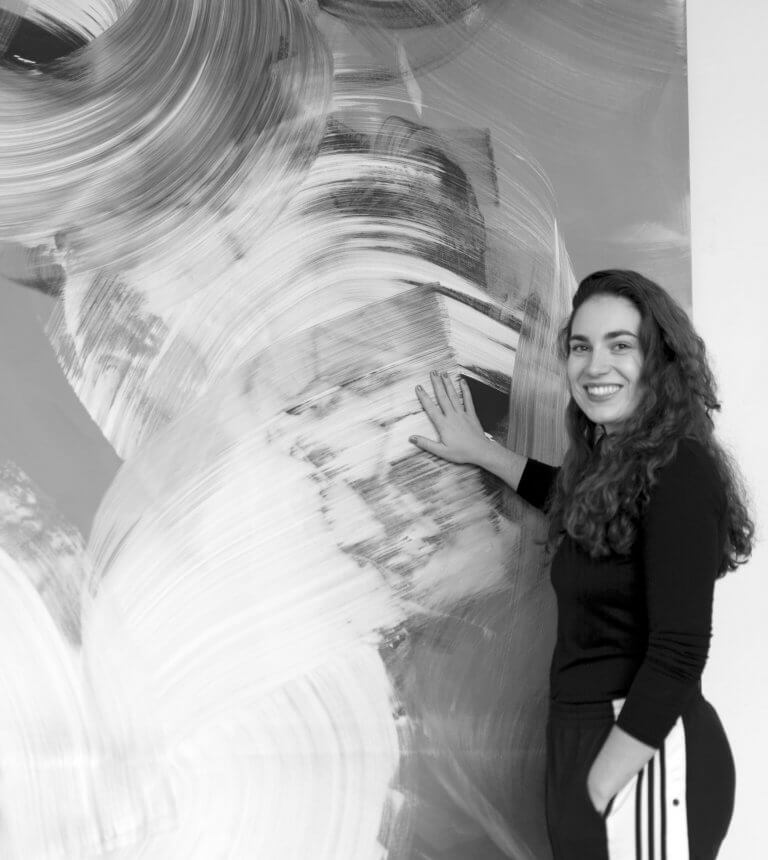
The paintings created by the artist Laura Aberham, who lives and works in Düsseldorf, are defined by their color intensity and incredible dynamic. Her use of color and form is confident and extremely powerful, and her mostly large-scale, abstract works appear gestural and at the same time precisely composed. Laura Aberham's paintings are a tribute to color. With gestural, voluminous brushstrokes, she skillfully brings unusual color constellations onto the canvas in many layers; here, color itself becomes the concept. The artist, who graduated from the Kunstakademie in Düsseldorf as a master’s student under the direction of Ellen Gallagher, found her very own artistic style through her very physical approach to color. At the beginning of her studies, she attended sculpture classes, where she internalized her experiences with volume and dynamics. She continued to apply her experiences with structure, form, and space into her paintings. Due to their spatiality and physical dynamics, Laura Aberham's works appear to continue beyond the edge of the canvas into the space of the viewer.
To the artist page
Constantin Schroeder
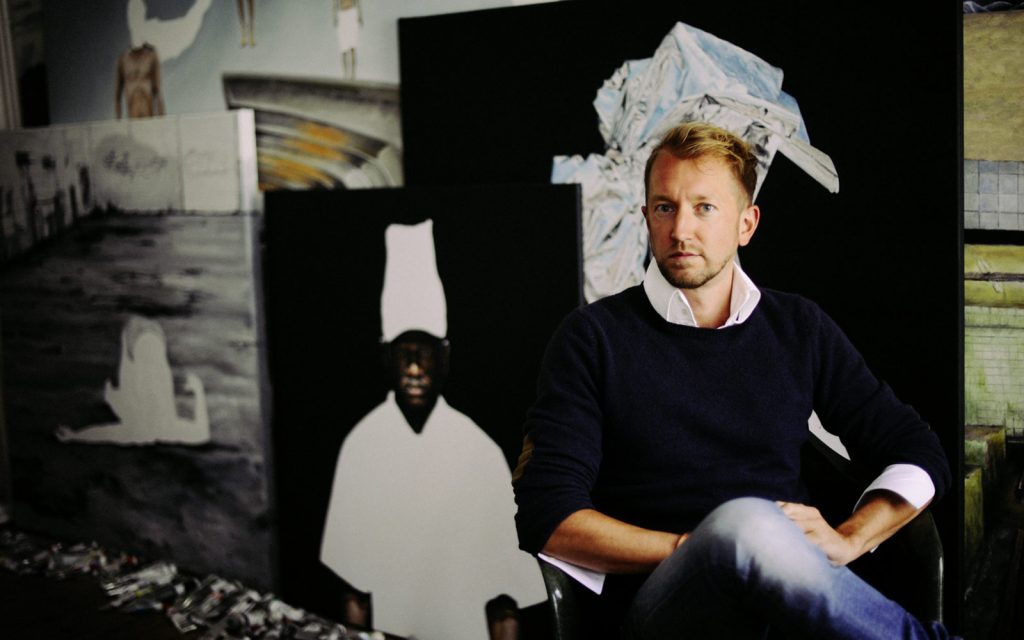
Constantin Schroeder's figurative paintings are impressive, moving images with a profound sense of depth. His pictorial protagonists are fascinating characters that never let us go. Internalizing the present with all its complexities, he uses a very reduced color palette. Mostly executed in large formats, the scenes captivate the viewer with their characteristic narratives. Schroeder reaches deep into the archive of the human psyche. His works reveal an enigmatic iconography, which includes young heroes posing interpersonal mysteries. The artist, who lives and works in Berlin and studied theology, philosophy, and art history, also illuminates the darker sides of life in an extraordinary, hyper-realistic style. These are powerful images that captivate us with their enigmatic pictorial content. Schroeder leaves some parts of the image white, which allows the viewer to develop his or her own interpretation and understanding of the image through open associations.
To the artist page
Leszek Skurski

"Condensation is the starting point of my painting."
- Leszek Skurski
This guiding principle forms the foundation upon which Leszek Skurski builds his visual worlds. His journey began at the Academy of Fine Arts in Gdańsk, where, at the age of just 22, he was honored with the Polish State Prize for Painting. Over the decades, he has perfected a signature style that moves between the fleeting and the enduring, and today is recognized as Neo-Impressionism. His works are the result of heightened attentiveness and a persistent commitment to decisions that, once placed on the canvas, must stand on their own.
In these compositions, white becomes the true protagonist. It is not an empty background, but a pulsating, expansive surface that lays bare every movement and mark without protection. What remains in this space has passed the test of reduction. Skurski’s figures, often caught in waiting or transition, do not embody mere actions but a quiet, existential presence. By letting the faces recede in favor of posture, the viewer’s gaze is freed to perceive a being that transcends the individual.
It is this deliberate omission of detail that conjures a calm in which time loses its usual pace. Fleeting moments of daily life, memories of what has been seen, and deep sensations merge here until they coalesce into a single, concentrated situation. A space emerges in which the everyday loses its casualness and acquires a timeless validity. What remains is the essential, a silent and powerful assertion of the moment that resonates far beyond the edges of the canvas.
To the artist page
Roberto Bernardi

Roberto Bernardi's keen eye for detail and passion for traditional painting techniques were evident from an early stage in his artistic training. In 1993, he moved to Rome, where he initially worked as a restorer. However, he soon decided to give up restoration work in order to devote himself entirely to his own art.
His first solo exhibition followed in 1994, achieving success and bringing him public recognition and positive reviews from local critics. Since then, Bernardi's work has been presented in 15 solo exhibitions worldwide, including in New York, London, Paris, Detroit and Singapore.
A stylistic turning point came in the early 2000s, largely influenced by his frequent stays in New York. During this time, he established contacts with renowned artists such as Richard Estes, Chuck Close, Tom Blackwell, Ralph Goings and Charles Bell. He participated in group exhibitions with them at international museums.
Over the past ten years, Bernardi's work has evolved significantly. His hyperrealistic compositions increasingly show influences from Pop Art. Today, he exhibits hyperreal sculptures worldwide that focus primarily on sweets, lollipops, and other confectionery — colourful works that inspire with their precision.
To the artist page