KiafSEOUL

03.Sep - 07.Sep 2025

From September 3 - 7, 2025, we will be presenting our artists at this year's KIAF:

Leszek Skurski, Constantin Schroeder, Eunjeong Kim and Robert Bernardi

Eunjeong Kim

Floating 10

acrylic and oil on canvas

300 x 120 cm

€ 9.000,00

Roberto Bernardi

MINI EQUILIBRISTI 2

UV resistant resin

42 cm

€ 4.400,00

Roberto Bernardi

MINI EQUILIBRISTI 3

UV resistant resin

54 cm

€ 6.200,00

Roberto Bernardi

EQUILIBRISTI CXXVII

resin

93 cm

€ 21.400,00

Roberto Bernardi

L'OTTIMISTA

oil on canvas

35 x 30 cm

€ 7.500,00

Roberto Bernardi

PASSIONE NASCOSTA

oil on canvas

35 x 39 cm

€ 7.500,00

Roberto Bernardi

Via Parallele

oil on canvas

105 x 125 cm

€ 26.500,00

Roberto Bernardi

Sugar Duck

oil on canvas

70 x 55 cm

€ 12.000,00

Roberto Bernardi

The Big Candy

oil on canvas

130 x 160 cm

€ 26.500,00

Constantin Schroeder

Bugatti I

oil on canvas

110 x 100 cm

€ 7.900,00

Constantin Schroeder

Bugatti II

oil on canvas

110 x 100 cm

€ 7.900,00

Eunjeong Kim

In Between I

oil and acrylic on canvas + AR

125 x 160 cm

€ 8.800,00

Eunjeong Kim

In Between II

oil and acrylic on canvas + AR

100 x 120 cm

€ 6.800,00

Eunjeong Kim

In Between III

oil and acrylic on canvas + AR

82 x 120 cm

€ 6.300,00

Eunjeong Kim

In Between IV

oil and acrylic on canvas + AR

125 x 100 cm

€ 7.000,00

Leszek Skurski

Captive Balloon

acrylic on canvas

100 x 160 cm

€ 10.400,00

Best Trio

oil on canvas

60 x 50 cm

€ 4.400,00

Leszek Skurski

Far de Favàritx

oil on canvas

60 x 50 cm

€ 4.400,00

Roberto Bernardi

L'ESTREMO DESIDERIO

oil on canvas

55 x 65 cm

€ 13.800,00

Leszek Skurski

On Painting, Silence, and the Flow of Time

Leszek, many of your collectors describe your paintings as especially calm, even meditative.
Do you yourself experience that calmness while painting – or is your studio life quite different?

It’s probably the colour white that makes this sense of calm feel so present. I never explicitly searched for calmness, but I do like working in an environment where I’m not distracted. That said, painting is not monotonous in my case – it’s very focused, and never truly quiet.

You work in Fulda and sometimes in Mallorca – a place of light and vastness – and you grew up in Poland.
How do these contrasts influence your sense of space, colour, and artistic identity?

That’s a question I ask myself a lot. I grew up in Gdańsk in the 1980s, where

everything was quite grey in general. I think that’s why monochrome compositions came so naturally to me. It’s not that I don’t enjoy working with colour – I do, very much. But somehow, ideas in white feel more honest to me.

Your recent monograph mentions the importance of “happy accidents.”
Has there been a recent moment when chance unexpectedly enriched a painting?

Yes, of course – usually out of frustration when something doesn’t work. Then I completely change the concept to free myself from the idea I no longer believe in. Sometimes it’s even worse. But sometimes, something remarkable emerges. Then I ask myself: What did I just do?! And it’s hard to repeat.

The playwright Heiner Müller is quoted there, saying: “It’s the leap that creates the experience – not the step.”
Has there been a particular leap in your practice or career that felt especially important?

Yes – but you only recognise it much later. That’s the strange thing about art. You try things, experiment, keep creating, and eventually you can look back and see the leaps. I still believe that my piece Abgang was such a leap. It was the moment I knew what I had to do – no doubts. A complete flow.

Many people wonder when you decide that a painting is finished.
Is there a clear moment, a specific feeling – or is it different each time? There’s that old truth among artists: it’s finished when it’s hung on the gallery wall. Over time, I think each artist develops a feeling for that particular moment – the sense that the work couldn’t be any better.

Your works are neither loud nor explanatory – and that’s what makes them timeless.
Is that openness something you aim for – or does it emerge in the process? Wait a minute! Some of my paintings actually scream at me. I know they have that energy – and they can also be extremely quiet. That kind of contrast heightens the atmosphere and maybe helps others step into my world. At least I hope so.

You’ve created nearly 3,000 works, yet you still seem curious and open to new directions.
Is there anything you’re determined to explore or change in the future?

It feels like I still need to paint ten times that amount. It’s hard to decide what to do next – and at the same time, it’s a great feeling to know the time is limited. That makes each decision more important. I’ve planned so many concepts, but there’s only so much time.

Just today I spent hours photographing and observing cliffs. An incredible subject – art historically, a total highlight. But to do it justice, I’d probably need two years. I still need to think about it.

One last question, almost poetic:
In many of your paintings, different moments seem to take place simultaneously – as if time is dissolving.
Do you feel a different sense of time while painting?

Yes, very poetic – and I think that’s partly why we do what we do, as artists: to stop time. Both within the artwork and during the process itself. The world keeps turning, and I invent my own time machine – using paint and dirty hands... oh, sorry: paint isn’t dirt.


To the artist page

Constantin Schroeder
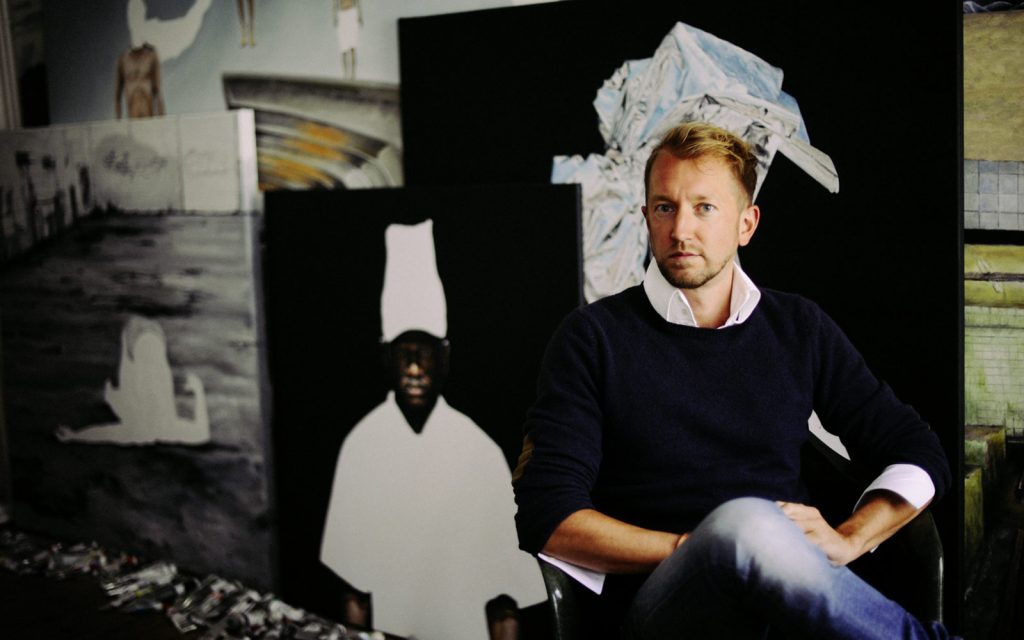
Constantin Schroeder's figurative paintings are impressive, moving images with a profound sense of depth. His pictorial protagonists are fascinating characters that never let us go. Internalizing the present with all its complexities, he uses a very reduced color palette. Mostly executed in large formats, the scenes captivate the viewer with their characteristic narratives. Schroeder reaches deep into the archive of the human psyche. His works reveal an enigmatic iconography, which includes young heroes posing interpersonal mysteries. The artist, who lives and works in Berlin and studied theology, philosophy, and art history, also illuminates the darker sides of life in an extraordinary, hyper-realistic style. These are powerful images that captivate us with their enigmatic pictorial content. Schroeder leaves some parts of the image white, which allows the viewer to develop his or her own interpretation and understanding of the image through open associations.


To the artist page

Roberto Bernardi

Roberto Bernardi's keen eye for detail and passion for traditional painting techniques were evident from an early stage in his artistic training. In 1993, he moved to Rome, where he initially worked as a restorer. However, he soon decided to give up restoration work in order to devote himself entirely to his own art.

His first solo exhibition followed in 1994, achieving success and bringing him public recognition and positive reviews from local critics. Since then, Bernardi's work has been presented in 15 solo exhibitions worldwide, including in New York, London, Paris, Detroit and Singapore.

A stylistic turning point came in the early 2000s, largely influenced by his frequent stays in New York. During this time, he established contacts with renowned artists such as Richard Estes, Chuck Close, Tom Blackwell, Ralph Goings and Charles Bell. He participated in group exhibitions with them at international museums.

Over the past ten years, Bernardi's work has evolved significantly. His hyperrealistic compositions increasingly show influences from Pop Art. Today, he exhibits hyperreal sculptures worldwide that focus primarily on sweets, lollipops, and other confectionery — colourful works that inspire with their precision.


To the artist page

Eunjeong Kim

Eunjeong Kim studied fine arts at the Hochschule für Bildende Künste in Braunschweig. She is a contemporary artist living and working in Germany. Kim is a truth seeker who explores the world of abstract purity. Continually exploring the essence of pure forms and lines, she creates an independent visual language free from pre-determined meanings. Through the use of various media such as painting, digital collage, sculptural installation, 3D animation, AR and VR, the artist aims to expand the dimensions of painting and evoke different sensations.


To the artist page
Request